Past Publications
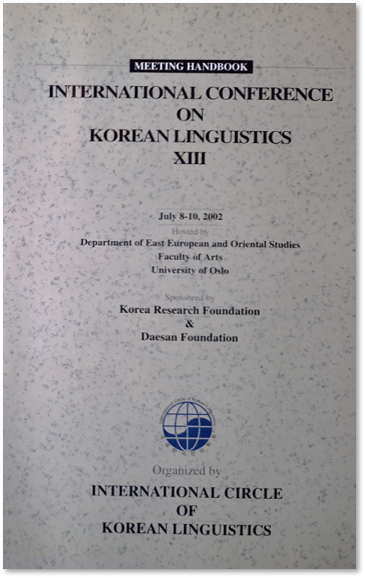
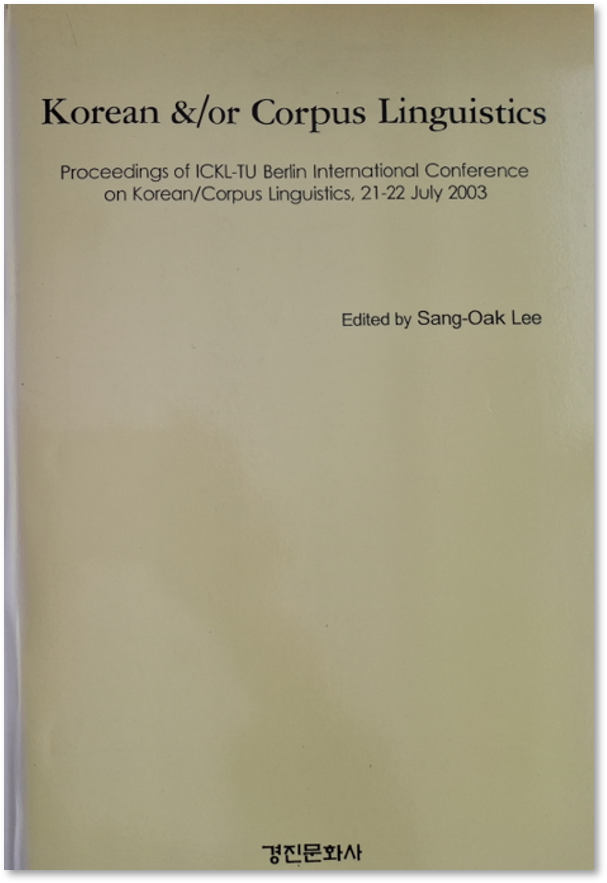
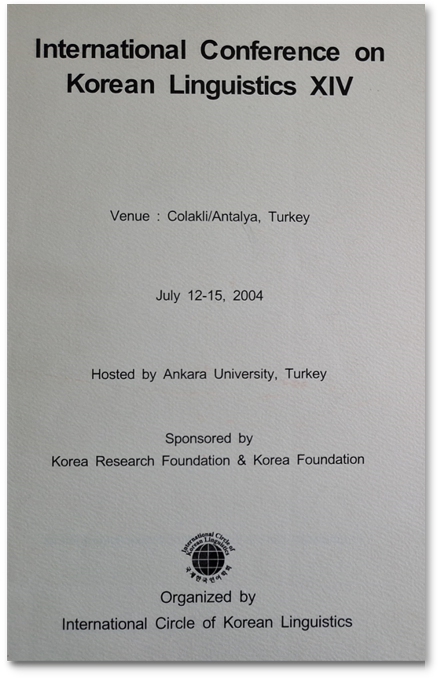
2002, 2003, 2004, 2006, & 2008 Conference Proceedings
Books originating from ICKL events
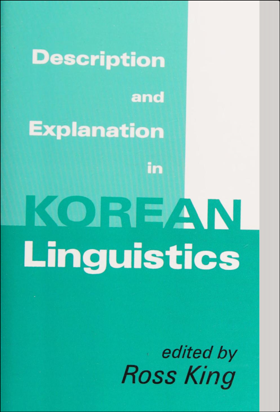
Description and Explanation in Korean Linguistics
Edited by Ross King
Cornell East Asia Series, 2010
This volume brings together fifteen new papers on Korean linguistics originally presented at the Ninth International Conference on Korean Linguistics, 1994. Contributions range from phonetics and phonology, to syntax and grammaticalization, and address important theoretical issues from a wide variety of formal frameworks. The volume contains new research by established scholars like Gregory Iverson, Young-Key Kim-Renaud, Susumu Kuno, and Joan Maling, as well as papers by relative newcomers to the field: Sung-ock Sohn, Jae-Hoon Yeon, Mark Vincent, Chang-Bong Lee and Yoon-suk Chung.
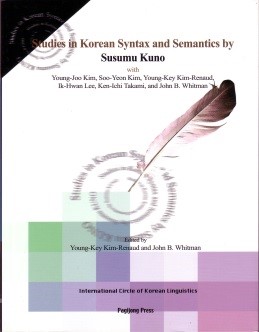
Studies in Korean Syntax and Semantics
Edited by Young-Key Kim-Renaud and John B. Whitman.
International Circle of Korean Linguistics / Seoul: Pagijong Press, 2004
By Susumu Kuno with Young-Joo Kim, Soo-Yeon Kim, Young-Key Kim-Renaud, Ik-Hwan Lee, Ken-Ichi Takami, and John B. Whitman
The nine articles on Korean syntax and semantics collected in this volume showcase Kuno’s contribution to Korean linguistics. These articles are testimony to Susumu Kuno’s boundless inventiveness, powers of observation, and sensitivity to language data.
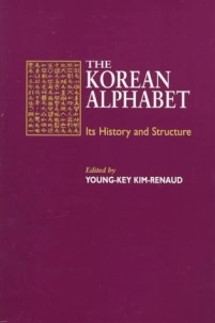
The Korean Alphabet: Its History and Structure
Edited by Young-Key Kim-Renaud
University of Hawaii Press, Honolulu, 1997
This collection of essays, written by some of the most active scholars of the Korean writing system is the first book-length work in English. It addresses the cultural-historical and theoretical-linguistic background of the Korean alphabet. Essay topics include arguments for Sejong's "personal creation" of the script (Ki-Moon Lee); Asian and domestic linguistic and socio-cultural background leading to the invention of the script (Gari Ledyard); principles under which each symbol was created (Pyong-Hi Ahn and Sang-Oak Lee); sound values and phonological changes of Korean vis-à-vis the writing system (Sinhang Kang and S. Robert Ramsey); structure of phonological units and featural analysis of the script (Young-Key Kim-Renaud and Chin-Wu Kim); systematic presentation of orthographic divergence between the two Koreas (Ho-min Sohn); and experimentations with Korean writing in Russia and the USSR (Ross King).
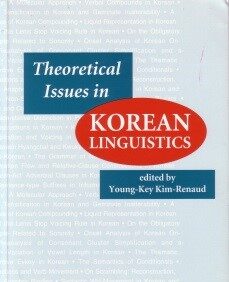
Theoretical Issues in Korean Linguistics
Edited by Young-Key Kim-Renaud
Stanford: Center for the Study of Language and Information, 1994
This volume contains a collection of 30 articles reflecting the dynamic and lively state of Korean linguistics today. Areas represented include theoretical phonology, morphology, and syntax, semantics, historical linguistics, discourse/pragmatics, and first language acquisition. The papers were chosen from those presented at the Eighth International Conference on Korean Linguistics.
| King Sejong the Great: The Light of Fifteenth Century Korea Edited by Young-Key Kim-RenaudThe International Circle of Korean Linguistics, 1992, 1997 (Revised edition)This book is about Korea's golden age and its cultural hero, King Sejong (r. 1418-1450), inventor of the Korean alphabet. This concise, well-illustrated volume covers in a consistent format the major aspects of traditional Korean culture and civilization in easily accessible, reliable and insightful chapters, each written by a recognized leader in the field. Individual chapters cover: King Sejong’s life; the Royal Annals (Sillok); Confucianism; rites; the Korean alphabet; printing innovations; poetry; music; the arts; ceramic arts; science, technology and agriculture; medicine; law and the development institutions. |
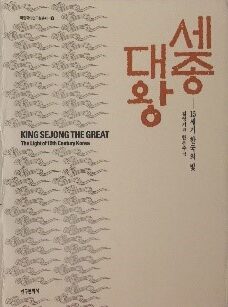
A bilingual edition: Korean translation of the King Sejong book with the English original
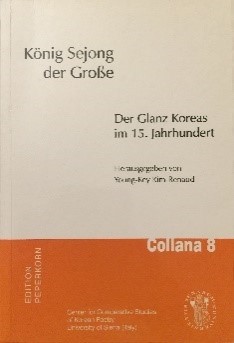
German translation of the King Sejong book